Searchlight is Aztek's marketing news roundup that brings together the week’s most relevant developments in marketing, search, AI, and digital strategy, all in one place. We update this article throughout the week with news we think is worth your time, along with context to help you understand what changed, why it matters, and what it could mean for your business.
This week's topics:
03/30: What Google’s March 2026 Core Update Means for Search Visibility
Google’s March 2026 core update is rolling out now, which means some businesses may see rankings and traffic shift over the next couple of weeks. That part is not unusual. Core updates tend to create movement across search results as Google adjusts how it evaluates content quality, relevance, and usefulness.
What matters more is how you read that movement. This is not really about obsessing over one keyword or reacting to every dip in a rank tracker. It's about whether your most important pages are still visible for the searches that actually matter to your business.
What Happened
Google has officially started its latest core update, and said that it may take up to two weeks to complete. That means any early swings in rankings or traffic are still part of a moving picture, not a final outcome.
That is an important distinction because core updates are broad changes, not site-specific penalties. Some businesses will see gains, some will see losses, and plenty may not see much change at all. The takeaway is not that something is wrong every time visibility shifts. It's that Google is continuing to refine what it sees as the most relevant and useful results.
What It Means for Search Visibility
For businesses that rely on organic traffic, visibility is the real issue to watch. A single ranking drop doesn't always mean much on its own. But if several key pages start losing ground across the searches that drive qualified traffic, that is worth paying attention to.
This is where core updates usually bring people back to the same basic truth: strong visibility tends to follow strong fundamentals. Pages that are genuinely useful, clearly written, and aligned with what people are looking for tend to hold up better than pages built mainly to capture rankings. Google doesn't always get that evaluation perfectly right, but that is still the general goal.
What Businesses Should Watch Right Now
For now, the smart move is to stay measured. Watch the pattern, not the noise. If one keyword moves down for a day or two, that's not much of a story. If visibility drops more broadly across your core service, product, or high-intent pages after the rollout settles, that is a better reason to dig deeper.
That deeper look should focus on a few practical questions.
- Are your pages actually answering the searcher’s question clearly?
- Do they feel distinct from the other results competing for the same search?
- Is the experience on the page helping people find what they need, or just giving Google a lot of SEO signals without much real value?
Those are not flashy questions, but they are usually the right ones. Core updates rarely reward frantic cleanup for the sake of looking busy. More often, they expose where a site is still thin, generic, or not as useful as it should be.
The Practical Takeaway
Google’s March 2026 core update matters because it can reshape who gets seen in search, even when nothing dramatic has changed on the surface. For brands, that's the real point. Visibility is earned a little differently every time Google refines what it values.
So yes, watch the rollout, but don't turn it into a panic event. Use it as a check on whether your site is doing the basics well: clear content, real usefulness, strong alignment with search intent, and a better experience than the next result. That's still the work that tends to hold up, no matter how many updates Google pushes through.
03/31: SEO, AEO, GEO: What’s Real and What’s Just Search Jargon?
Over the last year, marketers have started throwing around a growing list of acronyms tied to online visibility: SEO, AEO, GEO, and whatever new variation shows up next. Some of that reflects a real shift in how people find information. Some of it is just the industry doing what it does best: taking an existing idea, changing the label, and acting like everyone needs a brand-new playbook.
The truth is somewhere in the middle. Search behavior is changing as AI-generated answers, conversational tools, and zero-click experiences become more common, but that doesn’t mean businesses need to panic every time a new acronym shows up on LinkedIn.
Why These Terms Are Suddenly Everywhere
The reason these labels are spreading is that discovery is no longer happening in just one place or one format. Traditional search results still matter, but now users are also getting answers directly from Google, AI tools, and other platforms that summarize information instead of just listing links.
That shift is real; what’s less clear is whether each new acronym represents a truly separate discipline. In most cases, they’re better understood as different ways of describing visibility within a changing search environment.
What’s Actually Different, and What’s Mostly Overlap
At a high level:
-
SEO is still about helping your site and content get discovered in search.
-
AEO is usually framed around showing up in direct answers.
-
GEO is often used to describe visibility inside generative AI responses.
That may sound like three separate strategies, but the overlap is hard to ignore. Clear content, strong site structure, trustworthy information, and useful answers have always mattered (and they still do). The format of discovery may be changing, but many of the fundamentals are not.
That’s where some of this terminology starts to get overcomplicated. If a page is genuinely useful, well organized, and aligned with what people are looking for, it has a better chance of performing across search experiences, whether someone clicks a blue link or reads a generated answer.
Where The Confusion Becomes A Problem
The problem starts when businesses mistake new language for a completely new strategy. That’s when teams start asking whether SEO is dead, whether they need to rebuild everything for AI, or whether they’re already behind because they haven’t adopted the latest acronym.
Some of these terms are helpful shorthand. They can describe real differences in how visibility happens, but they can also create false urgency, especially when the naming gets ahead of the actual work. Renaming SEO every few months might be good for conference decks, but it’s not much of a strategy.
What Businesses Should Actually Focus On
The solution? Don’t optimize for acronyms. Optimize for usefulness, clarity, and credibility wherever people search. That means:
-
publishing content that answers real questions
-
structuring pages in ways that are easy to understand
-
strengthening trust signals on your site
-
making sure your digital presence reflects actual expertise
Those things don’t just support traditional SEO. They also give your brand a better shot at showing up in newer AI-driven experiences.
The Bigger Search Shift
Businesses should absolutely pay attention to how discovery is evolving. AI answers, conversational search, and changing user behavior are worth watching, but most companies don’t need a brand-new strategy for every new acronym that pops up. What they do need is a strong website, useful content, clear messaging, and a digital presence that’s built to earn trust. That may not sound as flashy as the latest search acronym, but it’s still the part that does the heavy lifting.
04/01: Why Data Quality Is Becoming a Bigger Factor in Google Ads Performance
Google Ads has spent years moving further toward automation. As that shift continues, the quality of the data flowing back into the platform matters more because Google is using those signals to make more of the decisions that shape performance.
Google has also been talking more openly about the link between stronger first-party data and better ad performance. Its recent push around Data Strength is one of the clearest signs that it wants advertisers paying closer attention to the quality, completeness, and usefulness of the data feeding the platform.
Stronger first-party data gives Google a better view of what happens after the click, which helps its systems optimize around outcomes that are actually useful to the business. Seen through that lens, this is less about adopting new platform language and more about recognizing a broader paid media shift: better data is becoming a bigger part of better Google Ads performance.
What Google Means by Stronger Data
At a high level, Google is encouraging advertisers to give the platform a more complete picture of what happens after the click. That can include reliable website tagging, richer conversion information, enhanced customer data, and business data that may live outside the browser.
If Google only sees part of the customer journey, it can only optimize around part of the picture. If it sees better signals around leads, purchases, revenue, and customer actions, it has more context for bidding and optimization.
That doesn't mean every advertiser needs an elaborate setup, but it does mean the quality of the data flowing into Google Ads matters now that automation is doing so much of the work.
What Stronger Google Ads Data Looks Like in Practice
In practical terms, stronger data usually starts with a reliable tagging foundation. If core actions are not being captured consistently, the rest of the setup has less to build on.
From there, the next step is making conversion data more meaningful. A basic lead form completion tells Google something. A qualified lead, a purchase value, or a sale tied back to revenue tells it much more. The platform can make smarter decisions when the signal reflects business value instead of surface activity alone.
There is also growing value in connecting other data sources that fill in gaps. Depending on the business, that could mean CRM data, backend purchase records, offline sales information, or enhanced conversion data. The details vary by account, though the goal stays the same. Give Google a clearer view of what success actually looks like.
What This Means for Google Ads Advertisers
The business takeaway is not that every advertiser needs a complex rebuild. It's that measurement quality deserves more strategic attention than it used to.
For some businesses, the next step may be cleaning up sitewide tagging and checking whether conversions are firing correctly. For others, it may be improving conversion definitions, passing better value data back into the platform, or connecting sales data that currently sits in a separate system.
The common thread is that stronger campaign performance increasingly depends on stronger inputs. That's true for large advertisers with complex setups, and it's becoming more relevant for smaller and mid-sized businesses too.
Why Better Data Quality Matters in Google Ads
Data quality is becoming a bigger factor in Google Ads performance because the platform is increasingly built to act on the signals advertisers provide. When those signals are incomplete, optimization has limits. When those signals are stronger, Google has a better shot at making useful decisions.
That is the real takeaway here. Advertisers don't need to get overly hung up on the terminology, but they do need to understand that better data is becoming a more important part of better paid media performance.
04/02: ChatGPT Location Sharing: What Local Businesses Need to Know
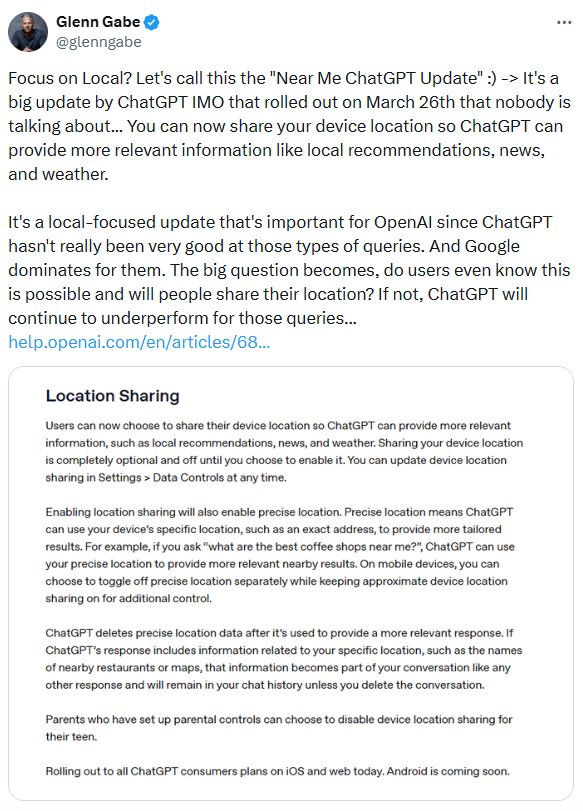
On March 26, OpenAI quietly rolled out optional location sharing for ChatGPT on web and iOS (Android is “coming soon”). Users can now toggle on approximate or precise location under Settings → Data Controls. When precise is enabled, the assistant can read an exact address long enough to answer the prompt, then deletes that data.
Early tests show the feature is imperfect, one widely shared example returned steakhouses 45 minutes away, but it’s the clearest signal yet that conversational AI wants to own “near me” searches.
Why It Matters
ChatGPT already handles a surprising volume of local intent. A January study found 75% of sessions still include keyword-style prompts like “dentist 11214.” If even a fraction of those users flip on location sharing, they’ll expect answers that rival Google Maps. Businesses with sloppy listings or thin reviews could vanish from an emerging discovery channel before they notice.
Who Should Pay Attention
-
Brick-and-mortar retailers counting on foot traffic.
-
Service-area brands (plumbers, HVAC, home care) whose crews need efficient routing.
-
Multi-location healthcare and restaurant groups already juggling Google Business Profiles.
If ChatGPT starts surfacing a competitor two blocks away, it won’t matter that your Google ranking looks fine, the consumer may never hit a search engine.
Practical Next Steps
-
Audit Your NAP Everywhere
Make sure name, address, phone, hours, and categories match across Google, Apple, Yelp, Bing Places, and your own site.
-
Refresh Local Schema
Add LocalBusiness or location-specific Organization markup with latitude/longitude and opening hours.
-
Earn Recent Reviews
LLMs lean on sentiment signals. Ask happy customers to leave Google or Yelp feedback this quarter, not last year.
-
Test Weekly Prompts
Run a short list of “best near me” queries with location sharing on. Track whether you appear and which sources ChatGPT cites.
-
Stay Tuned for Business Profiles/Ads
OpenAI hasn’t announced monetization, but ad placements are already in pilot elsewhere in ChatGPT. Make sure you have clean data ready before they flip the switch.
Key Takeaway
ChatGPT location sharing won’t dethrone Google overnight, but it’s a clear step toward AI-first local discovery. Brands that keep their local data tight today will be ready when conversational “near me” moments scale tomorrow. In other words: fix the basics now, so you’re not invisible later.