Backlinks are not just links. They are third-party endorsements that search engines have historically treated as evidence of credibility. The problem is that bad endorsements can do long-term damage.
As a business, authority matters. Proving your brand as a reliable, trusted source is critical for search engine optimization (SEO), and purchased backlinks can undermine your reputation. Unfortunately, pressure from AI overviews and zero-click search drive some marketers to prioritize short-term results over a real foundation for business growth.
Worried that your agency is buying bad backlinks? We break down why they’re a detriment to digital success and how to spot the red flags, backed by a real audit.
Why Your Backlinks Matter
When a relevant, authoritative site points to your content, it signals that your page earned attention outside your own ecosystem. That signal still influences rankings, but the environment around it has changed: as search becomes more answer-driven and clicks become harder to win, the incentive to manufacture endorsements has grown.
The problem is that synthetic authority does not behave like real authority. It leaves patterns, degrades over time, and can become a liability when platforms decide to discount it.
Why This Conversation is Back
Shady SEO practices, often called black hat SEO, date as far back as the late ‘90s and early 2000s. Keyword stuffing, hidden text, and buying links were all common practices to manipulate search engines into boosting ranking, at least until those same search engines aggressively penalized sites using these methods.
While the days of black hat SEO date back decades, it hasn’t gone away. Backlinks still matter, and that truth creates temptation. When links correlate with rankings, and rankings correlate to your sales pipeline growth, the shortcut can look obvious, especially when organic growth is harder to generate than it was even a few years ago.
Organic Traffic is Under Pressure
Multiple independent datasets show a continued shift toward fewer clicks from search results and more “answer-first” experiences. Pew’s analysis of Google users found people were less likely to click traditional results when an AI summary appeared, and clicks on links inside the summary were rare. Zero-click behavior is also now a baseline condition, with SparkToro’s research estimating that only a minority of searches result in clicks to the open web.
As competition intensifies for a smaller share of available clicks, backlinks have become increasingly commoditized. Entire ecosystems have formed around link exchanges, private blog networks (PBNs), and large-scale link farms designed to artificially inflate authority signals.
Search engines adapt, but the incentive structure does not disappear. Ranking well still drives revenue, and backlinks still correlate strongly with organic performance, which is why the market for manufactured authority keeps resurfacing.
However, the risk profile has changed. Google’s own guidance is explicit that buying or selling links intended to manipulate rankings violates its spam policies, and its spam systems are designed to neutralize link spam so any “lift” from it can simply disappear. In practical terms, that makes link buying both less reliable and more expensive to unwind. The same shortcuts that once produced predictable lift now introduce compounding uncertainty, including devaluation, remediation work, and reputational exposure that extends beyond search performance.
Google’s Position on Paid Backlinks is Not Ambiguous
Google’s spam policies prohibit buying or selling links intended to manipulate rankings. Google also provides a clear mechanism for legitimate paid relationships: qualify paid links using rel="sponsored" (or nofollow) so they do not pass ranking signals. When link spam systems neutralize spammy links, any prior “benefit” is effectively removed.
The Practical Problem: “Relabeling” Does Not Change the Transaction
Many backlink programs are sold under softer language: “editorial placements,” “authority link campaigns,” “sponsored content partnerships,” or “guest posts.” The label is irrelevant if backlinks hit any of the following criteria:
- The intent is manipulation
- Placement is guaranteed for payment
- Links are followed when they should be qualified
What Purchased Backlink Patterns Look Like in a Real Audit
Below are three screenshots from a backlink audit (SEMrush Backlink Analytics) that illustrate the patterns we look for when we are validating an agency’s claims. If you are evaluating a current agency (or hiring a new one), these are the exact “tells” that should trigger a deeper review.
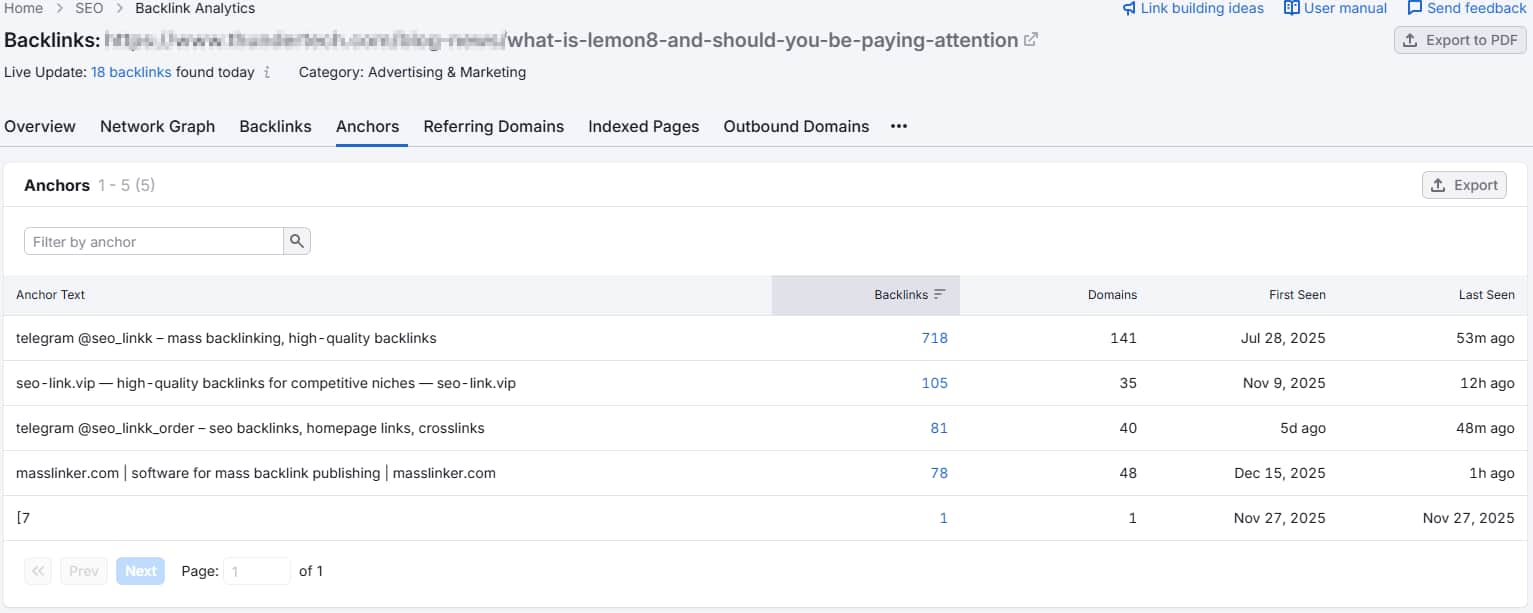
Red Flag No. 1: Anchor Text that Advertises the Purchase
Purchased links often leave fingerprints in anchor text. The most obvious examples include spammy commercial phrases, repeated templates, and anchor text that references link-selling channels directly (including Telegram handles).
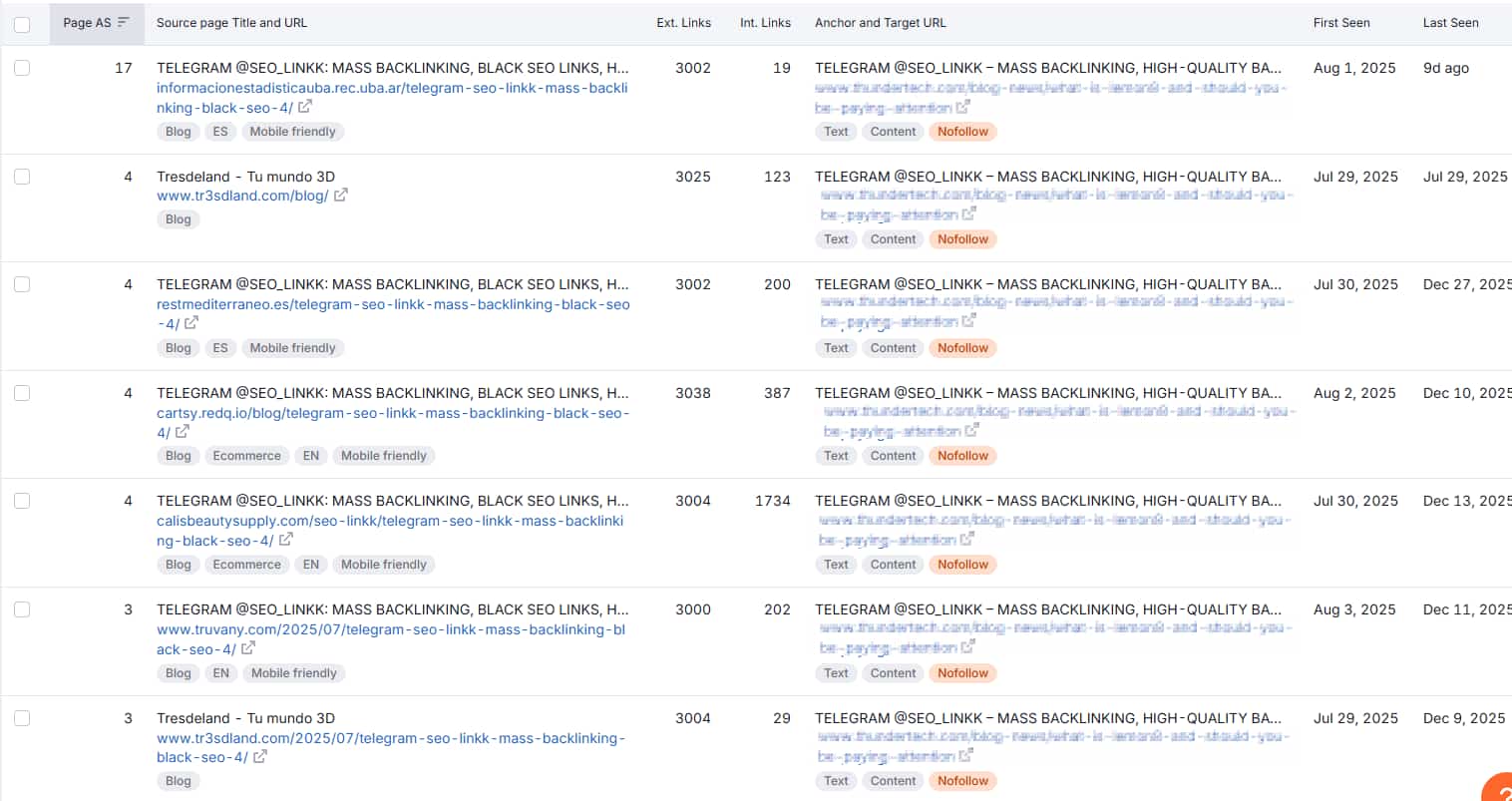
Example: Repeated, promotional anchor text across hundreds of backlinks and many referring domains is a classic paid-network signature.
Red Flag No. 2: Bulk, Low-quality Domains Pointing to a Single Page
Organic editorial links rarely arrive in clusters of near-random subdomains, especially when they appear in bulk and point to one specific URL. When you see dozens of low-quality sites (including free-hosted blog networks) all linking to the same destination within a tight window, you are usually looking at a paid placement blast or automated distribution.
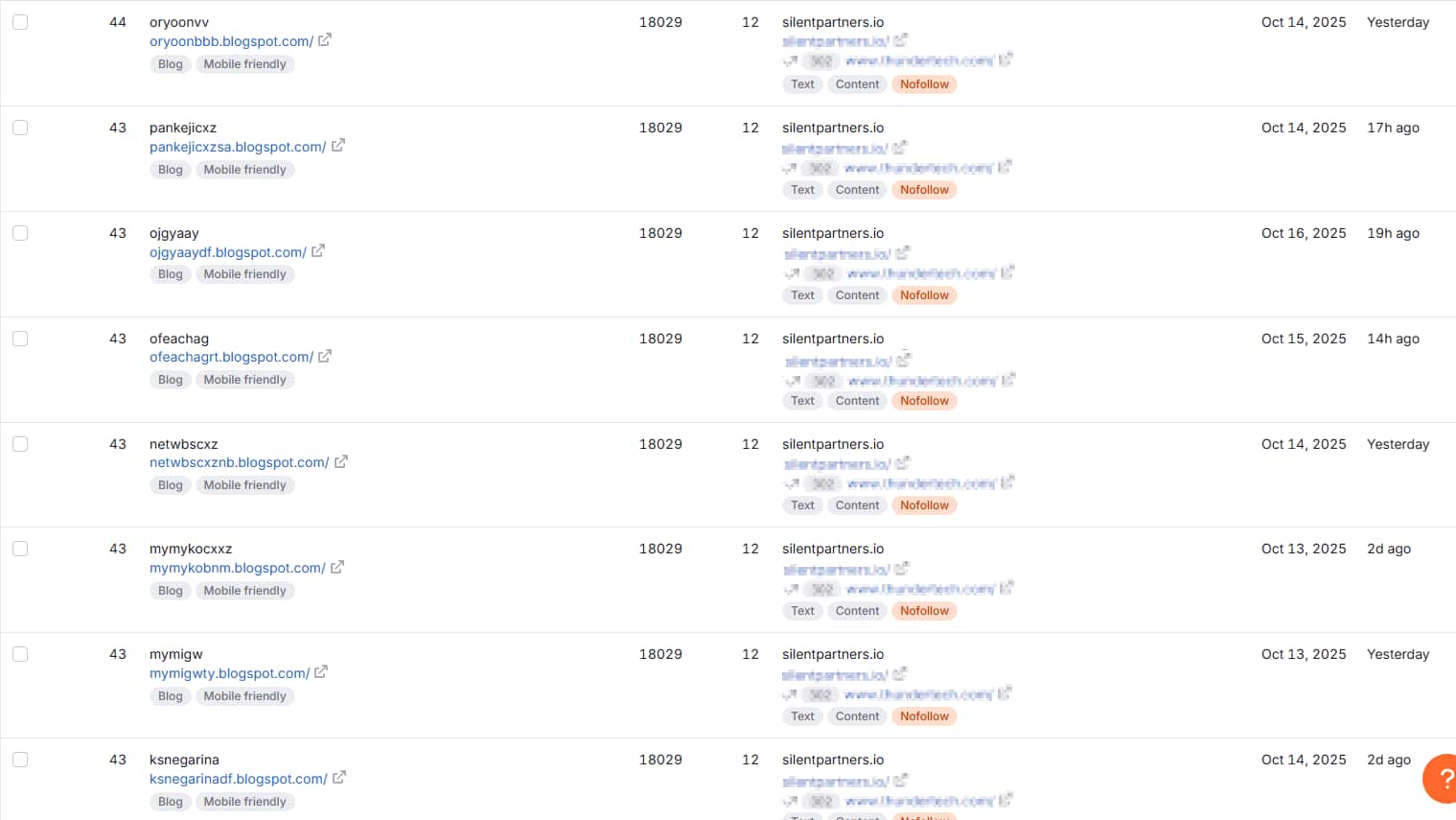
Example: Many Blogspot subdomains linking to one page. This pattern is consistent with bulk link placement rather than editorial discovery.
Red Flag No. 3: “Bad Link Placement” Footprints in the Source Pages
One of the easiest ways to spot a purchased link is to look at the page that is being linked. Link farms exist to publish outbound links at scale, which often shows up as unusually high numbers of links that have the same irrelevant context in the anchor text. For a new page, this might be the only type of link placement they currently have:
Example: Source pages with extremely high outbound link counts and templated link text are a common paid-network footprint.
Why Buying Backlinks is Unsafe (Even When “It Works” Short Term)
Link buying is not just a rules issue. It is a compounding risk across performance, governance, and brand credibility. Even when rankings temporarily improve, the profile becomes fragile and expensive to maintain.
Risk No. 1: Algorithmic Neutralization With No Reliable Recovery Timeline
Link spam systems can discount unnatural links without a manual notice. When the system neutralizes the effect, the “lift” disappears. That change can create a false narrative where the agency claims volatility, seasonality, or “core updates,” when the root cause is a synthetic link profile.
Risk No. 2: Profile Degradation Over Time (Link Rot is Real)
Backlinks disappear constantly: pages get deleted, sites change ownership, posts are edited, and networks collapse. Paid link networks are especially brittle, which means clients often pay repeatedly just to maintain the appearance of progress.
Risk No. 3: Reputational Exposure During Diligence or Audits
Unnatural link profiles can surface during mergers and acquisitions (M&A) diligence, investor reviews, compliance audits, or brand safety reviews. Even if there is no penalty, the optics are problematic: it signals weak vendor controls and a willingness to use shortcuts.
The AI Era Makes Synthetic Authority Less Useful
Search is shifting from “ten blue links” toward answer engines and AI summaries. In that environment, the value of authority is not just rankings, it is whether your brand is consistently referenced and trusted across the web.
Brand Mentions and Genuine Citations Matter
Emerging research suggests AI visibility correlates strongly with real brand presence (mentions and trusted references), not manufactured backlink volume. That factor is another reason link buying is strategically misaligned with where discovery is going.
How to Audit Your Current or Future Agency for Backlink Red Flags
You do not need special access to Google to validate whether an agency is building a clean backlink profile. You need transparency, repeatable reporting, and a short list of checks that reveal link buying patterns quickly.
What to Ask (and What “Good” Sounds Like)
- Do you pay publishers or intermediaries for link placement?
- Good answer: “No. We pay for labor (PR, content, outreach) but do not buy followed placements.”
- How do you handle sponsored opportunities?
- Good answer: “We qualify paid links appropriately (sponsored or nofollow).”
- Can you provide a placement list with URLs, context, and whether links are sponsored/nofollow after a campaign?
- Good answer: “Yes, and we include screenshots for context.”
- What percentage of performance relies on backlinks vs content, technical SEO, and brand PR?
- Good answer: “Links are an outcome, not the strategy.”
- Can links be removed if requested?
- Good answer: “We work closely with publishers to ensure the best quality placements. We can always reach out to the publisher to request that a placement is removed.”
What To Check in Common Tools (SEMrush, Ahrefs, Search Console)
- Anchor text distribution: Look for repeated templates, commercial phrases, or unnatural keyword repetition.
- Referring domain quality and clustering: Look for low-quality platforms, free-hosted blog networks, and sudden bursts.
- Source page context: Open the linking page. If it exists to publish outbound links, treat it as a toxic signal.
- Link velocity: Spikes without a corresponding PR event or content launch are suspicious.
- Manual actions and disavow needs: If you suspect paid link schemes, prioritize removal requests first and consider disavow only as a last resort.
Download: How to Choose the Right Digital Marketing Agency
Want to find an agency that prioritizes your long-term growth instead of quick wins that pose problems? Download our guide on everything you need to consider when choosing the right partner for your brand.
What Earning Links Actually Looks Like
Legitimate link acquisition is slower and more defensible. It usually comes from a variety of effective tactics that drive external sources to link to your site:
- Publishing original research
- Creating tools or assets worth citing
- Executing digital PR campaigns with editorial independence
- Building partnerships where links are incidental, not transactional
Aztek’s Commitment to Quality Backlinks
At Aztek, we do not purchase backlinks or participate in link schemes designed to manipulate rankings. We focus on earning editorial links through content quality, technical excellence, and genuine visibility.
SEO is not about shortcuts. It is about building systems that withstand scrutiny, algorithm updates, and time.
Ready to partner with an agency that relies on transparent, practical strategies instead of flashy, short-term gimmicks? Contact us today about how we can help you build authority through honest strategies that yield real results.