Aztek’s Marketing News Roundup brings together the week’s most relevant developments in marketing, search, AI, and digital strategy, all in one place. We update this article throughout the week with news we think is worth your time, along with context to help you understand what changed, why it matters, and what it could mean for your business.
AI has made marketing production faster than it’s ever been. Blogs can be drafted in half the time. Ad variations can be generated almost instantly. Reporting summaries can be pulled together in what feels like minutes.
But a lot of teams are learning the hard way that faster output isn’t the same thing as faster results. In fact, AI can make a team look busy while performance stays flat, because it shifts the hard work to the parts of marketing that don’t automate cleanly.
Why Output Gets Faster, But Results Don’t
AI speeds up creation, but creation was never the only thing standing between you and better performance. Once the draft exists, the real work starts.
That’s where teams still spend time:
making sure the message matches the offer, the landing page, and the sales conversation
pressure-testing claims for accuracy, compliance, and brand risk
getting the right content in front of the right audience
measuring what happened, then turning that into a smarter next step
When AI makes drafts “cheap”, the “expensive” part becomes everything required to make those drafts true, aligned, and effective.
The Real Cost Is Context
AI can generate a clean, confident draft in seconds. The catch is that real marketing doesn’t live in a vacuum. Every message has to fit your actual business rules, brand standards, and how your team sells.
That context is where speed can turn into risk, because AI doesn’t automatically know:
What your sales team can realistically promise and deliver
What your legal or compliance team will sign off on
What counts as substantiation in your category
What your positioning would never claim, even if it sounds compelling
Two Places Human Intervention Prevents Marketing Slip-Ups
Example 1: The “confident claim” problem
AI can write persuasive copy that sounds specific, even when it shouldn’t. It might suggest a stat like “cut costs by 30%” or language like “guaranteed results” because it reads well.
A marketer catches that and asks the questions that matter: Do we have proof? Can we support that number? Is that wording allowed in this category? The difference isn’t writing ability, it’s judgment.
Example 2: The “policy mismatch” problem
AI can also create a mismatch between what you say and what your business can actually honor. That can look like an offer description that doesn’t match the real terms, a promo that implies eligibility your rules don’t support, or a product explanation that conflicts with your own documentation.
Want a real-world example? Air Canada’s website chatbot gave a customer incorrect guidance about how a bereavement fare refund worked. The customer relied on it, Air Canada denied the refund, and a tribunal found the airline responsible for what its chatbot communicated.
A human who understands the offer, the fine print, and the edge cases catches that kind of mismatch before it becomes a trust issue (or a legal one).
Review Becomes the Bottleneck
As output increases, review load rises. In marketing, review isn’t just proofreading. It’s brand standards, compliance risk, audience fit, and conversion logic.
If AI creates a flood of “pretty good” drafts, senior marketers can end up spending all their time editing instead of improving strategy, performance, and measurement. That’s when teams feel busy, but not faster.
How High-Performing Teams Use AI Without Creating Noise
AI works best when it helps you move faster through execution, without skipping the thinking. Think of it like a power tool: it saves time, but the result depends on the person using it.
A simple starting point:
Use AI to get to a strong first draft faster. Generate a starting version or a couple of variations, pick one direction, then test it.
Use AI as a safety check. Ask it to flag risky claims, tone mismatches, or vague calls-to-action.
Use AI to learn faster. Summarize results, spot patterns in search terms, or pull themes from sales notes to improve the next round.
The teams that get real gains from AI usually aren’t the ones publishing the most. They’re the ones putting out fewer, higher-quality campaigns, then adjusting based on what the data is actually telling them.
You can already see this playing out on major platforms. YouTube has said reducing low-quality AI “slop” is a priority in 2026, which tells you something important: once AI makes content production easier for everyone, just putting out more of it stops being a competitive edge. The advantage shifts back to quality, relevance, and whether the content is actually useful to the person seeing it.
AI in Digital Marketing: The Real Key to Better Results
AI makes marketing output easier. That’s a real advantage, as long as it’s used inside a clear strategy.
The difference between “more content” and “more results” is still human-led work: deciding what to say, who it’s for, what proof supports it, where it belongs in the funnel, and what success should look like. AI can accelerate production, but it can’t replace the judgment that keeps campaigns focused, accurate, and conversion-ready.
If your team feels busier but not faster, don’t assume AI isn’t useful. It may reveal the real constraints: planning, alignment, review, and measurement. Tighten those pieces, and AI becomes a multiplier instead of a noise machine.
03/10: AI Voice-Over Hits Performance Max
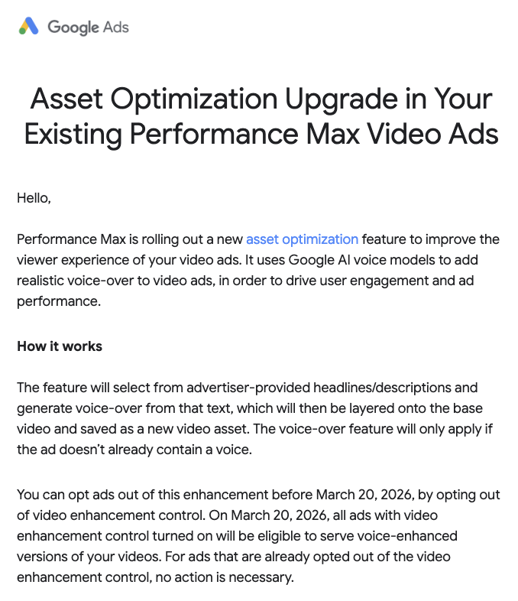
Google is rolling out AI-generated voice-over for eligible Performance Max video ads, using advertiser-provided headlines and descriptions to create spoken audio and layer it onto existing videos. Based on the rollout details shared publicly, advertisers who want out need to act before March 20, 2026, and the feature applies to ads that do not already contain a voice.
Performance Max upgrade notice from Google
At Aztek, we do not think advertisers should shrug this off as a harmless enhancement.
This is being framed as a viewer experience and performance update, which is exactly how Google tends to present these kinds of changes. On paper, that sounds fine. Better engagement? Sure. More efficient creative production? Ok. The problem is that once a platform starts generating spoken messaging for your brand, this stops being a basic asset tweak. It becomes a communication choice, and that deserves more scrutiny than a checkbox in campaign settings.
Why the Voice Part Changes the Conversation
A silent video and a spoken video do not land the same way. That sounds obvious, but it is exactly why this matters. The text advertisers load into Performance Max was usually written to be scanned, not heard. Headlines are often short, compressed, and built for speed. Descriptions are usually there to support the asset mix, not carry the full weight of a spoken message.
When Google turns those lines into voice-over, the advertiser is no longer dealing with text placement. They are dealing with tone, rhythm, emphasis, and overall brand feel. That is where this feature gets risky.
Something that looks perfectly acceptable on screen can sound awkward, repetitive, or oddly stiff when spoken out loud. Even if the AI voice sounds good, polished is not the same thing as on-brand. A realistic voice is still the wrong voice if it delivers the message in a way that doesn’t sound like your company.
The Bigger Issue Is Default Automation
What makes this rollout more uncomfortable is not just the feature itself. It is the rollout style. It will be an automatic activation for eligible accounts after March 20 unless advertisers disable the relevant controls. That fits a broader pattern in Performance Max, where Google continues to add AI-driven creative changes while leaving advertisers to opt out, as opposed to opting in.
Google’s own help documentation around video enhancements says these enhancements are turned on by default and can be switched off, and its documentation around creative video automation also says advertisers can remove unwanted enhanced assets or disable the feature at the campaign level.
That distinction matters. There is a real difference between giving advertisers a tool they can choose to use and quietly expanding the system’s authority over how their ads are presented. One is optional creative assistance. The other is a platform making messaging decisions unless someone catches it in time.
An Account Management Issue
For in-house teams with a small account structure, this may just be a quick settings review. For agencies or multi-location advertisers running a lot of Performance Max campaigns, it becomes more than that.
The control is handled at the campaign level, which means teams may need to review campaign settings individually rather than rely on a simple one-click account-wide choice. That turns this from an abstract AI debate into a real workflow issue. If you manage a large portfolio, you now have a deadline, a settings audit, and a new layer of creative review to worry about.
That matters because it changes the cost of inaction. If a team misses the deadline, the consequence is not just that a new feature exists. The consequence is that Google may start serving voice-enhanced variants of ads that were never approved in that format.
Where We Land
We are not anti-AI on this. We are anti-autopilot, which is why we always advocate that clients turn off all auto-apply features. There are absolutely advertisers who may test this and find that it improves performance. There are also advertisers whose videos would benefit from a stronger audio experience, especially if they have been relying on silent creative by default. Google has been pushing the idea for a while that video enhancements can improve campaign effectiveness, and its support materials repeatedly position automated video variations as a way to improve performance.
Still, that does not mean every advertiser should leave this on and hope for the best.
Our view is simple: If Google is going to speak for your brand, you should be far more cautious than the rollout language suggests. Review your headlines. Review your descriptions. Ask whether that copy still works when heard instead of read, then decide whether the feature belongs in your account.
Convenience is not the same thing as control. Performance is not the same thing as message quality. And a realistic AI voice is not automatically your brand voice.
03/11: AI and the Future of Work
A new Anthropic research paper adds some needed nuance to one of the loudest conversations in business right now: what AI is actually doing to the labor market.
The report takes a pretty technical approach, comparing what AI could theoretically do with how people are actually using it, then stacking that up against labor market trends. That’s the academic version. The practical version is simpler: so far, there still isn’t much evidence that AI is causing widespread job disruption, even in roles that seem more exposed on paper.
Too much of the AI labor conversation swings between two extremes. Either AI is about to wipe out white-collar work, or the whole concern is overblown. This Anthropic report supports a more grounded view. The dramatic collapse has not happened, but that doesn’t mean nothing is changing. It means the effects are showing up in more subtle ways first.
The Gap Between What AI Could Do and What People Are Actually Using It For
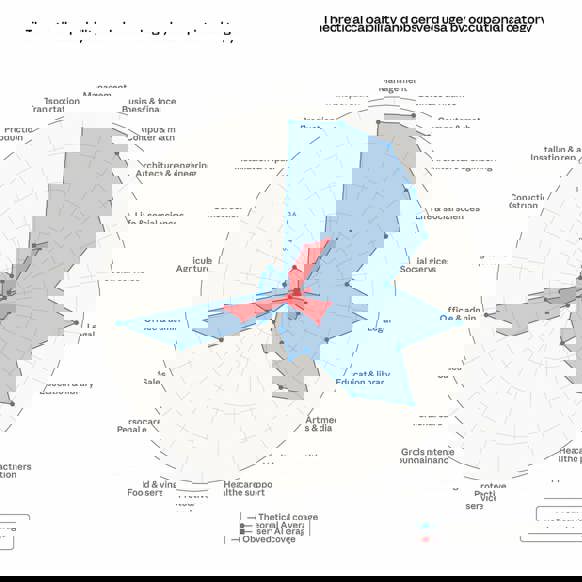
One of the most useful points in the research is the difference between theoretical capability and actual adoption. Anthropic found that AI is still being used for only a fraction of the work it could theoretically help with. In categories like Computer and Math, for example, the report says current coverage is still far below what is technically feasible.
Share of job tasks that LLMs could theoretically perform (blue area) and our own job coverage measure derived from usage data (red area).
That distinction matters because marketers, business leaders, and agency teams keep making the same mistake: they treat technical possibility like immediate business reality. Those are not the same thing. A tool can be capable of doing part of a job long before it’s adopted widely or implemented in a way that meaningfully changes headcount.
From our perspective, that is the lens more teams need right now. AI is not just a replacement story. It’s a story about adoption curves, workflow redesign, verification needs, and management choices. That may sound less dramatic, but it is probably closer to what most businesses are actually living through.
Why This Matters for Marketing Teams
The report also found that jobs with higher AI exposure are expected to see slower growth through 2034, based on Bureau of Labor Statistics projections, though the relationship isn’t especially strong. It also didn’t find a clear rise in unemployment for highly exposed workers since late 2022. What it did point to was something a little more subtle: there are early signs that hiring may be slowing for younger workers in more exposed roles.
That feels especially relevant for marketing because this is exactly the kind of work AI can speed up without fully taking over. Drafts come together faster. Summaries are easier to execute. Content variations don’t take as long. But none of that gets rid of the need for judgment. Someone still needs to make sure the message is accurate, the offer makes sense, the campaign lines up with sales reality, and the content still sounds like the brand.
That’s why the bigger impact in marketing may not be immediate job loss. It may be a shift in how roles are structured and what teams expect from them. Fewer entry-level people may be expected to handle the same amount of production work. Junior roles may be harder to break into. Mid-level and senior marketers may end up carrying more of the strategy, oversight, and decision-making.
A Warning Against Lazy Thinking, Not Against AI
There is a tempting habit in AI conversations to flatten everything into one question: Will this replace people or not? That’s the wrong question to ask.
Better questions to ask are:
What kinds of work get easier?
What kinds get devalued?
What kinds become more important?
Anthropic’s data points to a messier reality than the usual AI takes. If unemployment isn’t suddenly jumping, but younger workers may be having a harder time getting into more exposed roles, that tells us the early impact may be showing up somewhere else. Not through massive layoffs, but through quieter shifts in hiring patterns and how jobs are being structured.
That’s the part businesses should be paying attention to. Waiting around for some dramatic labor market collapse misses what’s already happening in front of us. Companies are changing what they expect from employees. They’re rethinking who they hire, what they automate, and where human judgment still matters most.
Our Two Cents
This report is a good reminder that AI disruption is real, but the simple version of the story is still wrong. No, the data does not show that AI has triggered broad unemployment across exposed occupations yet. In fact, AI may sometimes be getting more credit, or more blame, than it deserves, especially when companies are really using it to explain right-sizing after a period of over-hiring. What the report does show is that businesses should be paying closer attention to where pressure may show up next, especially around hiring and expectations for knowledge work.
Our view is straightforward: panic isn’t useful, but complacency isn’t either. The smartest response is to stop framing AI as a clean replacement story and start treating it like an operating model shift. For marketing teams, that means the future probably belongs to people who can do more than produce. It belongs to people who can think, review, adapt, and make better decisions with faster tools.
3/12: Google Maps Adds Conversational AI Search
Google Maps has always been one of the most practical tools on the internet. You open it when you need directions. You use it to check hours. You search for a coffee shop, a gas station, a restaurant, or a place to stop on the way somewhere else.
That is starting to change.
Google just announced a major Maps update that brings Gemini deeper into the experience. The biggest headline is a new feature called Ask Maps, which lets people search in a more natural, conversational way. Instead of typing something basic like “coffee near me,” users can now ask more specific questions that sound closer to how real people think and talk. They can ask for a quiet coffee shop with places to charge a laptop, or for help planning a road trip. Essentially, they can ask for spots that meet a particular need rather than just matching a category.
At the same time, Google is also rolling out a much bigger navigation refresh. Coverage from Ars Technica and The Verge describes it as the biggest visual overhaul to Maps in more than a decade, with more immersive route guidance, richer 3D visuals, improved lane and road context, and clearer help once you get close to your destination.
On the surface, this looks like a product update. In practice, it’s another sign that search behavior keeps moving away from simple keyword matching and closer to assisted decision-making.
What This Update Actually Changes
The important shift here is not just that Google added AI to Maps. It's how AI changes the search experience.
Ask Maps is built to handle more layered, real-world requests. That means users are no longer limited to searching by business type and sorting through a list on their own. Instead, Google Maps can interpret context, preferences, and intent to deliver more tailored recommendations. The feature is also designed for more than one-off local searches. It can support broader trip-planning needs, which pushes Maps further into the role of a recommendation tool, not just a directions app.
That matters because it changes the role Maps plays in the customer journey. It's no longer just helping someone get from Point A to Point B; it's helping them decide where to go in the first place. For local businesses, that is a meaningful distinction. If Google Maps becomes more of a recommendation engine, then visibility is not only about being nearby, it's also about being relevant to the specific question the user is asking.
Why This Matters Beyond Google Maps
This update is part of a larger pattern marketers should be paying attention to. Across search, AI tools are changing how people discover businesses, compare options, and narrow choices. Instead of scanning a page of blue links or map listings, people are increasingly getting summarized answers, curated recommendations, and interface-level guidance that does some of the filtering for them.
A person looking for lunch is not just searching “best sandwich shop.” They may ask for a place with quick parking or seating that works for a casual meeting. A traveler is not just searching “things to do.” They may ask Maps to help build part of an itinerary. A parent is not just searching “restaurants nearby.” They may want somewhere kid-friendly that is easy to reach and not too crowded. The new experience is built around that kind of prompt. That raises the bar for what makes a business easy to discover.
Who This Impacts Most
This update will matter most to businesses that rely on local intent. That includes:
Restaurants
Retail Stores
Medical Practices
Home Service Companies
Hospitality Brands
Entertainment Venues
Tourism Operators
It also matters to franchise groups and multi-location brands. If discovery becomes more conversational, then every location needs a stronger digital footprint, not just the corporate website.
This is also a big deal for marketers managing local SEO, listings, reputation strategy, and content. Reviews, photos, business details, category accuracy, and overall profile quality may become even more important when the platform is trying to answer nuanced questions instead of just returning a list of nearby pins. Reporting around Ask Maps indicates Google is using the rich information already inside Maps, including reviews and photos, to support these recommendations.
What Business Owners Should Take From This
The takeaway is not “panic and rebuild your marketing plan.” The takeaway is that local visibility is getting more contextual.
If your Google Business Profile is thin, outdated, inconsistent, or missing the kinds of details a customer actually cares about, that becomes a bigger problem in a more AI-assisted environment. If your reviews are sparse, your photos are weak, or your business information does not reflect how people naturally describe what you offer, you are giving Google less to work with.
Business owners should be thinking about questions like:
Does our business profile clearly reflect what we actually do?
Do our reviews mention the qualities customers care about most?
Are we showing enough visual proof for someone deciding where to go?
Is our location data accurate across every touchpoint?
Those are not new questions. They just matter more now.
What This Means For Marketers
For marketers, this update is another reminder that discovery is becoming less about exact-match inputs and more about interpreted intent. That doesn’t mean traditional local SEO disappears. It means the supporting signals around it become more valuable.
Review strategy matters. Photo strategy matters. Profile completeness matters. On-site content that reinforces who you serve and what makes you different still matters too, especially when Google is trying to connect a real-world question to the most relevant answer.
It also means marketers need to pay closer attention to how customers describe needs in plain English. The future of search is not only built on keywords, it's built on context. The brands that show up well in that environment are usually the ones that make their value easy to understand everywhere, from listings and reviews to service pages and location details.
The Bigger Picture
The real story here is not that Google Maps got a chatbot; it's that one of the world’s most-used local discovery tools is becoming more conversational and more active in helping people choose. That is a meaningful shift for any business that depends on being found at the right moment.
For users, this may make Maps more helpful. For businesses, it means the quality of your digital presence has to carry more weight. For marketers, it's one more sign that platforms are moving toward answer-driven discovery, and that the businesses who win will be the ones that give those systems better signals to work with.
Sarah Brosious is a Strategic Content Manager at Aztek with more than 15 years of marketing experience. She works along side Aztek’s team of specialists to translate complex ideas into clear, approachable messaging that educates audiences, reinforces brand voice, and expands organic reach. When Sarah isn’t behind her keyboard, you’ll probably find her at the gym, watching birds, or trying out a new restaurant in the area.
AI is changing the way marketers operate, and you don’t need to have a big budget to join them. Discover ways that you can leverage AI for your business.
AI has fundamentally changed the rules of SEO. Discover how full-funnel marketing has evolved and how you can build strategies that thrive in an AI-driven funnel.