AI never ends, it just changes forms.
For years, businesses have relied on digital advertising to reach potential customers where they search for information. As the way people search has evolved, AI-powered search experiences are presenting new opportunities for paid advertising.
AI ads are big business these days. OpenAI launched ads in ChatGPT Feb. 9, 2026 and reached $1 billion in annualized revenue run rate by October. Google expanded ads in AI overviews and AI mode to international markets in October 2026 after first launching them two years prior. AI platforms are making it possible for brands to reach users, but are they worth adding to your strategy?
At Aztek, we've been experimenting with AI advertising to better understand how these opportunities work and what they could mean for our clients. Here's what businesses should know before deciding whether AI ads deserve a place in their marketing budgets.
What Are AI Search Ads, and How Do They Work?
AI search advertising refers to paid placements that appear within or alongside AI-powered search and discovery experiences. Rather than relying exclusively on traditional keyword searches, these placements use the context of a user's prompt to serve them relevant ads right in the chat interface or AI overview.
Let’s pretend that you’re an avid birder and want to create a backyard sanctuary for American woodcocks. You take to ChatGPT to create an action plan to support these beautiful birds behind your home. You provide context about your goals and specific needs, and that additional context creates an opportunity for ChatGPT to drop a relevant ad.
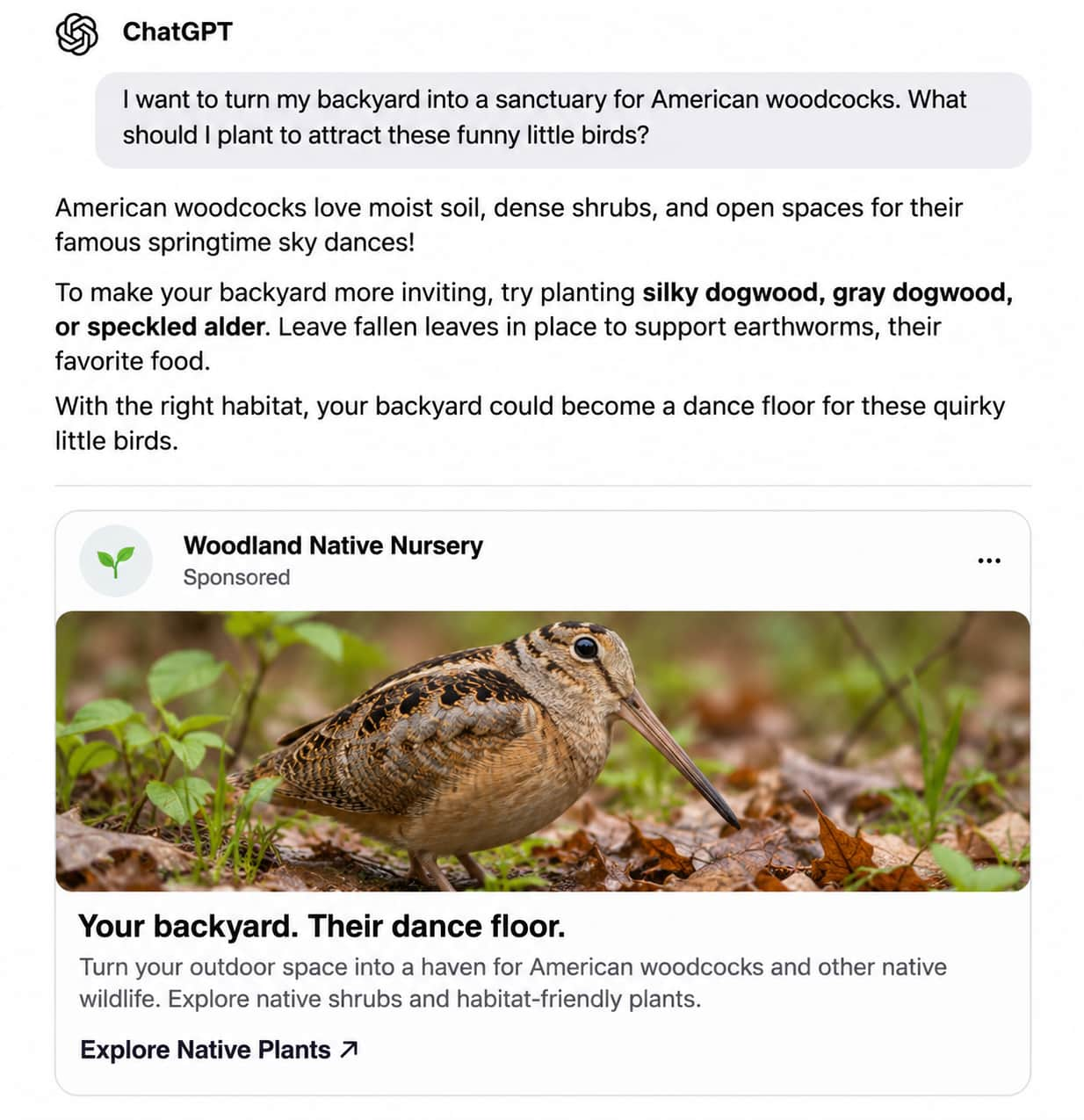
You never asked about nurseries, but ChatGPT determined that the context of your request was relevant enough to drop the ad. For B2B companies, the same principle applies. Someone researching a custom manufacturing supplier might ask an AI tool about materials, production requirements, supplier qualifications, or factors to consider when evaluating potential partners.
These conversations can reveal meaningful purchasing intent, even when users aren't searching for a specific company by name. With AI ads, your business can become part of those conversations.
How Are AI Ads Different from Traditional Search Ads?
Ultimately, AI advertising shares the same goal as traditional paid search: connect people with businesses that have goods or services they need based on their search. The major difference is that the two types of digital advertising
Something like classic Google ads is fueled by a specific keyword. A user searches for “best birdbath for my backyard” and the ad results are driven by that specific term. Meanwhile, AI ads are looking for the overall context for people asking broader questions to compare options or plan for their eventual bird sanctuary.
Both routes can yield results, but aren’t a one-to-one replacement for the other. AI ads are also much newer than Google ads and other paid tactics, and are continuing to evolve over time. As a result, there are a few key differences you should consider when comparing the two types of ads:
| Consideration |
Traditional Search Advertising |
AI Search Advertising |
| User behavior |
Often begins with a keyword or search phrase |
May involve detailed questions and ongoing conversations |
| Advertising relevance |
Commonly based on keywords, search intent, and other campaign signals |
May incorporate conversational context and user intent |
| Ad placement |
Typically appears on search results pages |
Can appear within or alongside AI-powered search experiences |
| Advertiser control |
Established campaign controls and optimization options |
Controls vary by platform and are still evolving |
| Performance history |
Mature benchmarks and established optimization practices |
Less historical data and fewer proven benchmarks |
Do You Need a Separate Google Ads Campaign for AI Overviews and AI Mode?
No, but there is still some nuances to how these ads differ from the ads you’d typically see in search engine results pages (SERPs). According to Google, any existing Google Ads campaign is automatically eligible to appear in AI overviews and AI mode. However, you can’t only target AI overviews and AI mode (at least not yet).
The tricky part is that these ads can show up due to either query matching or contextual matching. For example:
- If someone searches for a more transactional term, such as “squirrel-proof birdfeeders,” Google will match ads based on that keyword.
- If someone searches for the reason why squirrels won’t stop stealing from your birdfeeder and how you can stop those thieving, furry deviants, Google AI may match ads based on context alone.
The result is a mix of both worlds that has become the norm for digital advertisers. It’s not necessarily a bad change, but it is important to recognize.
What Results Should Businesses Expect from AI Ads?
Another major difference between AI ads and more traditional forms of paid advertising is what you should expect from these two tactics.
Google ads can help generate leads by reaching people actively searching for a product or service, especially when their search terms indicate they’re ready to request a quote, schedule a consultation, or make a purchase.
AI ads don’t operate that way. Contextual ads can reach people researching a topic, but that doesn’t necessarily mean they aren’t considering a purchase.
That distinction means that AI ads are more of a brand awareness play that an immediate lead generation tool. This process means that you’ll likely need multiple touch points before that user decides to go with your business. The key here is to recognize that AI ad results will look different than classic search ads, and that’s okay as long as it fits your overall marketing goals.
If You Commit to AI Ads, Give Them Time to Perform
One of the biggest mistakes businesses can make with a new advertising channel is expecting immediate results, whether that’s for AI ads or traditional Google ads. Campaigns need time to gather data, identify patterns, and support informed optimization decisions before yielding real results.
At Aztek, we recommend allowing at least three months to properly evaluate advertising performance, including new AI advertising campaigns. For B2B businesses with longer sales cycles, the full impact of a campaign may take even longer to understand. Giving your AI ad campaign time allows organizations to avoid making major conclusions while it gets going.
How Much Does AI Advertising Cost?
Budget is one of the first questions businesses ask when considering a new advertising opportunity. The problem is there is no single answer. The right budget depends on the platform, campaign objectives, competition, and the amount of data needed to evaluate performance.
However, there are some minimum costs that can help shape your expectations. Based on our experimentation with ChatGPT ads, we’ve found that budgets start around $25 per day, which equates to roughly $750 per month.
The problem is that simply meeting that minimum doesn't necessarily provide enough budget to meaningfully evaluate whether the channel is effective for your business. Based on our research, we’d recommend starting between $1,000 and $3,000 per month to truly test AI ads and see more meaningful results.
How to Prepare Your Website for AI Advertising
An AI ad can introduce someone to your business, but your website still needs to do the work of helping that visitor take the next step. While you don’t have control over when your ad is shown, you still dictate which landing page that users will see when they click your ad.
Good content is essential for both users and AI crawlers alike, and both your site’s content and the specific landing pages attached to your ads should follow a few best practices.
1. Make Your Products and Services Easy to Understand
Lengthy sentences with flowery language are fun to write, but clear, concise content is the goal here. Your landing page and other service pages should clearly explain what your business offers, who you serve, and what makes your products or services relevant to potential customers. For example:
- A manufacturer might include detailed information about applications, materials, capabilities, and industries served.
- A professional services business might include descriptions of service offerings, common challenges, processes, and the types of clients that are an ideal fit.
These details help potential customers determine whether your business fits their needs. They also support the broader work of making your content understandable and accessible to search engines and AI-powered discovery tools. An in-depth, well-structured page that clearly establishes relevance and makes it easy for users to scan information puts your ads in a better position to succeed.
Want to learn more about how AI decides if your pages are worthy? Check out our research on how LLMs discover and cite your content.
2. Match Your Landing Page to the Advertising Message
Whether you’re advertising on Google Ads or some AI platform, users should arrive on a page that speaks as directly to their needs as possible. An ad that leads to your homepage or content designed for organic traffic may do an okay job, but it may also create unnecessary work for someone who has already expressed a specific need.
A strong landing page is designed to speak more directly to people clicking on your ad. This audience is looking for more immediate confirmation that your landing page aligns with what they want. Meanwhile, content written for organic traffic may have more written copy to tell a longer story than what your ads audience needs.
Before increasing advertising spend, it's worth asking whether your landing page is giving visitors a clear reason to convert. Here are a few tips to improve your landing page:
- Make the headline and opening message as specific to the intended audience as possible instead of being more broad to accommodate organic traffic.
- Include a clear call to action (CTA) near the top of the page for users ready to commit, and secondary CTAs for guides or other content for users who aren’t ready to become a lead.
- Remove distractions that don’t support the action you want them to take, such as stripping away the main navigation.
- Provide content that supports the opening message, including testimonials, statistics, and other proof points that are easy to scan and won’t clog up the landing page.
3. Answer Questions Customers Are Already Asking
AI-powered search often starts with a question. Your landing page (and really any page in general) should be prepared to answer the questions that matter to prospective customers, especially those related to purchasing decisions.
Working common, related questions directly into your landing page is a great way to help AI crawlers pull your content as a resource. FAQs are a tremendous example. Adding an FAQ section with relevant topics to your landing page allows you to answer readers while showcasing what makes you different from competitors. For example, addressing topics such as:
- What factors should customers consider before choosing a solution?
- What information does your team need to provide an accurate recommendation?
- How does your process work?
- What should customers expect when getting started?
The key here isn’t to just add any question to tick boxes for crawlers. Stick with relevant questions and provide original insights that align with your customers' actual needs. The result is a content strategy that supports paid goals and makes users and robots happy.
Is AI Advertising Right for Your Business?
AI advertising is worth understanding, but that doesn't mean every business should immediately invest in it. Before you shift your budget toward AI ads, consider the following questions.
- Do you have clear advertising goals? Make sure you know what you’re trying to accomplish before investing in a new channel.
- How are your current campaigns performing? AI advertising might be worth exploring if your other campaigns are performing well. If they aren’t, you should focus on addressing those challenges or reconvene with your team to revisit your overall paid approach.
- Is your content ready to convert visitors? Check all your landing pages and other content so that the ads have a place that can realistically turn traffic into leads.
- Can you commit to the budget and time needed to learn? If you can’t commit to at least three months of AI ads, you should work on refining other campaigns.
Build Your Ad Strategy Around Business Goals, Not Just the Latest Trend
AI-powered search is creating new ways for businesses to connect with potential customers. However, it’s critical to determine if that opportunity makes sense for your business before you invest in it or dismiss it outright.
At Aztek, we provide informed, proactive digital advertising recommendations rather than simply encouraging clients to chase the latest marketing trend. We work with you to determine which channels make sense, the optimal way to allocate budget, and what results you'll need to measure.
Interested in what AI advertising could mean for your business? Reach out to Aztek today about your digital advertising goals. We'll help you evaluate existing opportunities and develop a strategy that makes sense for your business, whether that includes AI ads or not.